GPT-5.6 Luna vs GPT-6 Luna: Measuring Time to Correctness
Posted on Thu 24 September 2026 | 5 min read

A controlled comparison of GPT-5.6 Luna and GPT-6 Luna on real engineering work, measured by time to correctness.
Continue reading
Posted on Thu 24 September 2026 | 5 min read
A controlled comparison of GPT-5.6 Luna and GPT-6 Luna on real engineering work, measured by time to correctness.
Posted on Sat 22 August 2026 | Part 8 of Distributed Systems in Finance | 27 min read
Financial systems don't get the luxury of downtime. Exchanges, brokers, and trading engines must ship new releases while orders are flowing, positions are changing, and markets are moving, without violating correctness or state.
Posted on Sat 11 July 2026 | Part 4 of DeFi Engineering | 13 min read
Ethereum is a replicated state machine for shared financial state. The EVM executes transactions deterministically, atomically, and under gas constraints while moving money, collateral, debt, ownership, and liquidity.
Posted on Sun 21 June 2026 | Part 5 of DeFi Engineering | 15 min read
On-chain liquidity is capital under constraints: embedded in contracts, distributed across domains, consumed by transactions, and shaped by arbitrage capacity.
Posted on Sun 07 June 2026 | Part 6 of Building Real Trading Systems | 18 min read
A trading system cannot rely on speed alone. Reliable data capture, state management, replayability, and observability are what make live behavior debuggable and trustworthy.
Posted on Sat 16 May 2026 | 30 min read
High-throughput services spend much of their time waiting on I/O. Go's runtime addresses this by multiplexing large numbers of lightweight tasks through goroutines, an internal scheduler, and coordinated synchronization primitives.
Posted on Sun 03 May 2026 | Part 5 of Building Real Trading Systems | 19 min read
Small trading systems optimize code paths. Larger ones optimize data movement. Scaling beyond Pandas means treating storage layout, ingestion, and derived datasets as part of the backtesting engine.
Posted on Sun 12 April 2026 | Part 7 of Distributed Systems in Finance | 14 min read
Schema changes don't roll out atomically in real systems. Old and new versions coexist across services, making backward compatibility and long-term correctness unavoidable constraints.
Posted on Sat 21 March 2026 | Part 6 of Distributed Systems in Finance | 26 min read
Financial streaming systems must remain correct when reality intervenes. This article dissects crash mid-window recovery, checkpoint corruption, idempotent effects and deterministic replay when failures occur.
Posted on Sat 07 March 2026 | Part 4 of Building Real Trading Systems | 20 min read
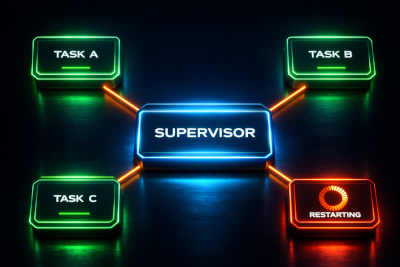
A production-ready async runtime architecture with explicit supervision and restart discipline, built to keep trading systems correct under failure, stress and load spikes.