Inside DeFi's Hidden Economy: MEV, Mempools, and the Battle for Blockspace
Posted on Sat 21 February 2026 | Part 6 of DeFi Engineering | 17 min read
Every blockchain transaction enters a game that isn't part of the UI.
The mempool is the arena. Validators, builders, searchers, relays are the players.
Latency is the currency. Flashbots and PBS define the ruleset.
And MEV is the score they optimize for.
The moment intent leaks, the game begins.

💡 Note: The examples in this article focus on Ethereum's main network, but the same dynamics show up anywhere transactions are visible before they're finalized.
The Hidden Marketplace Beneath Every Transaction
The moment a transaction hits the network, it becomes a signal. A piece of information broadcast into a swarm of actors that specialize in detecting, interpreting, and exploiting it at machine speed.
Most imagine a clean flow: send → wait → confirmed. In reality, that simplicity hides a marketplace built around one objective: extracting value from leaked intent.
Transactions Become Inventory
For searchers and validators, a swap or liquidation is public alpha. They simulate it, price it, and decide whether inserting themselves before or after that transaction yields profit.
In many ways, it mirrors High Frequency Trading: order flow becomes tradable intelligence, and the fastest actors can turn it into profit.
Ordering Is the Real Power
MEV reduces to a single principle. The position of a transaction determines who captures value.
- Searchers race to front-run or back-run emerging opportunities.
- Builders compete to assemble blocks with maximum extractable value.
- Validators choose whichever block proposal yields the highest reward.
The Mempool: The Arena Where Intent Leaks

Before a transaction ever reaches a block, it enters the mempool: a distributed waiting room shared across the network. It exists to give validators and builders visibility into upcoming work. Consequently it also exposes the earliest version of a user's intent to anyone fast enough to listen.
The mempool is built on a simple mechanism called gossip. Nodes broadcast incoming transactions to their peers, those peers rebroadcast further, until the entire network has a shared view of pending activity.
What emerges is an arena where raw intent leaks in real time and where the first competitive battles for MEV begin.
Public vs. Private Mempools
Most of this activity happens in the public mempool: open, globally visible, and accessible to anyone running a node.
But a parallel ecosystem has formed around private mempools. These are systems where transactions skip the public broadcast and go directly to builders or relays. This creates pockets of reduced visibility and different MEV games.
Latency and Information Asymmetry
Mempool data spreads through the network unevenly.
A few milliseconds of propagation lag can determine whether a searcher captures an arbitrage or misses it entirely. MEV essentially becomes a latency game: the mempool leaks alpha, but only to those positioned close enough to extract it before others do.
These asymmetries turn a simple gossip layer into a competitive battleground. A blockchain might offer deterministic settlement, but everything leading up to settlement is a PvP race.
Searchers and the Economics of Opportunity
Searchers are the actors built to exploit the intent leaks that blockchains produce. Their role is simple. They monitor pending transactions, simulate the future state of the chain, and decide whether inserting their own transactions into the block will generate profit. They are the economic predators of the system and also the ones who make markets efficient under adversarial conditions.
What Searchers Do
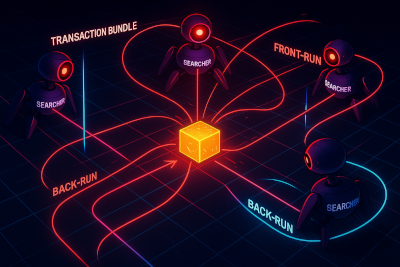
Searchers scan the mempool for patterns that represent extractable value. At a high level, they are looking for the following opportunities:
- Arbitrage: trading between liquidity pools/exchanges when prices are different.
- Liquidations: closing unsafe borrowing positions to seize discounted collateral.
- Sandwiches: profiting from the price movement caused by a large swap (the on-chain analogue of HFT front-running).
- Backruns: trading immediately after a transaction that changes pool state in a predictable way.
These actions only make sense in a world where transactions can be observed before settlement.
Simulation as a Competitive Advantage
Nothing is done blindly. Every potential opportunity is simulated before execution. Searchers run fast, deterministic models of what the next block would look like if they position themselves in a specific place relative to the observed transaction flow.
The game becomes: simulate → evaluate → submit → race. The searcher with the best simulation and the fastest execution wins.
Even after inclusion, the state is only conditionally stable until finality. Reorgs can reshuffle ordering, which means MEV strategies are always operating against a version of the chain that may still shift beneath them.
Bundles: How Searchers Express Value
Searchers submit bundles, which are ordered sets of transactions that only make sense together. A bundle effectively says: if these transactions are included in this order, the block will contain more value.
That value might come from an arbitrage, a liquidation, or a sandwich. The searcher has already simulated the outcome and encoded the strategy directly into the bundle.
From Searchers to Builders
Searchers don't realize MEV on their own. They simply propose it. Each bundle encodes a local opportunity: if this ordering happens, value is created.
Builders receive thousands of these proposals per block. Their role is to decide which combinations coexist, which conflict, and which ordering produces the highest total value. Builders don't care which searcher wins. They care about the aggregate result.
Why Searchers Exist
Searchers exist because public blockchains expose intent as part of their design. When a transaction enters the mempool, it reveals an upcoming change to prices, liquidity, or collateral. This temporary visibility creates opportunities that can be acted on immediately.
Searchers use leaked intent to close arbitrages, execute liquidations, and respond to price movements the moment they become predictable.
Builders, Relays, and PBS: Structuring the Race

As MEV grew into a market, blocks became engineered products. Optimized, simulated, and assembled for maximum extractable value.
That transformation created new roles in the supply chain: builders, relays, and the separation of responsibilities known as PBS (Proposer-Builder Separation).
Why Builders Exist
Originally, validators selected transactions, ordered them, and ran the normal consensus flow. They were building their own blocks.
But once MEV became significant, this model broke down. The search for optimal ordering became too computationally heavy and too competitive for individual validators to handle.
Builders emerged to specialize in one task: to construct the most profitable block possible. They simulate potential orderings, integrate searcher bundles, and produce a block candidate designed to maximize MEV revenue.
The Role of Relays
Relays sit between builders and validators. Their job is straightforward. Validators agree to a block without seeing its contents, so they can't copy it or selectively censor transactions. The relay acts as the middleman that enforces this blind handoff.
This changes the trust model. Relays decide which builders can submit blocks and which blocks reach validators. They don't create MEV, but they control the pipe it flows through.
PBS as the Modern Ruleset
PBS formalizes this split. Instead of validators both proposing and constructing blocks, the roles diverge:
- Builders assemble the block.
- Validators pick the best bid.
PBS standardizes how blocks are built and how value is expressed. Validators still make choices such as deciding which relays to connect to and which builders to accept blocks from. Discretion remains, even as block construction becomes more specialized.
The Rise of Private Order Flow
In order to avoid becoming public inventory, users and protocols began routing transactions privately, skipping the gossip layer and hiding intent from searchers.
Why Private Mempools Form
If an order can be sandwiched, backrun, or arbitraged the moment it hits the public mempool, then keeping it out of the public mempool is the obvious solution. Private mempools emerged as a way to hide intent and limit exposure to adversarial searchers.
How This Changes MEV Games
Once order flow moves into private channels, the original MEV dynamics shift. Searchers lose visibility, builders gain more influence and relays become new gatekeepers of who sees what and when.
The battleground moves from the public arena to curated pipelines.
Order Flow as a Commodity
Once intent stops being public, it turns into a resource.
Private order flow carries embedded alpha. Builders want it. Searchers want access to it. Protocols want to keep control over it. The flow itself becomes something to route, auction, or protect.
The result is a fragmented MEV landscape where access and routing shape who captures value.
TradFi discovered the same principle long ago: brokerages sell order flow because intent itself carries value.
MEV Isn't an Attack
MEV is often framed as something adversarial or malicious. In practice, it's neither good nor bad. It's just the natural result of how open blockchains work. Once ordering has value, an economy forms around it.
Value Extraction vs. Value Destruction
Not all MEV is harmful. Some forms of MEV make markets more efficient. Arbitrage closes price gaps, liquidations keep lending protocols solvent.
Other forms are clearly extractive. Sandwiching increases user slippage, intent leakage disadvantages retail users.
Treating all MEV as an attack misses this distinction.
The Real Challenge: Minimizing Harm, Not Eliminating MEV
The real challenge is to shape the incentives: reduce the most harmful forms and design systems where value extraction aligns with user outcomes instead of undermining them.
Private order flow, better execution primitives, and clearer separation of roles are all attempts in that direction.
MEV is the price of operating an open, adversarial financial system.

Blockspace as a Systems Problem
Blockspace is a scarce resource with price, power, and politics attached to it.
Searchers compete to extract value. Builders compete to package it. Validators compete to sell it.
It's where economics meets systems design. MEV is just the unavoidable consequence of running automated financial systems on shared, delayed state.