Understanding Latency: From Wire to Code
Part 1
Posted on Sat 15 November 2025
| 12 min read

Every microsecond counts, but where do they actually go?
Tracing the journey of a message from the network wire to application code reveals how NICs, interrupts, syscalls, and runtimes introduce latency at every hop.
Continue reading
Latency Profiling in Python: From Code Bottlenecks to Observability
Part 2
Posted on Sat 29 November 2025
| 19 min read

Understanding where time disappears in Python systems requires measuring both CPU and I/O behavior. Profilers, metrics pipelines, and continuous observability tools expose the performance patterns hidden inside production workloads.
Continue reading
Flow Control in Low-Latency Systems: Batching, Conflation, and Backpressure
Part 3
Posted on Sat 10 January 2026
| 15 min read
Low-latency systems fail when work becomes unbounded. Batching, conflation, and backpressure are mechanisms that keep systems stable under bursty, adversarial load. Without them, tail latency and cascading failures are inevitable.
Continue reading
Ring Buffers 101: The Building Block of Low-Latency Systems
Part 4
Posted on Sat 04 October 2025
| 12 min read
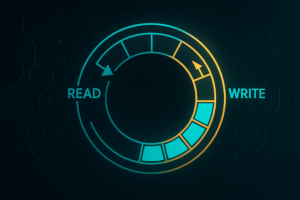
Ring buffers are a foundational data structure in low-latency systems. Their memory layout enables predictable performance and high throughput in real-time workloads such as trading engines, telemetry pipelines, and network processing.
Continue reading