Flow Control in Low-Latency Systems: Batching, Conflation, and Backpressure
Posted on Sat 10 January 2026 | Part 3 of Low-Latency Fundamentals | 15 min read
In low-latency systems, failures rarely show up as a uniform slowdown. Pressure builds in specific places: a queue grows, a handler blocks, a hot path saturates. Latency spikes, then cascades through the system.
The problem shows up when work arrives faster than the system can absorb it. Bursty and adversarial load push more through the system than it can safely carry. The failure begins when incoming work is allowed to pile up without bounds.
Flow control shapes how work is admitted, how it advances through the system, and how long it is allowed to wait. It keeps queues finite, limits amplification, and preserves predictability under load.
Batching, conflation, and backpressure form the core of that control. Used together, they balance throughput and responsiveness, allowing systems to stay stable under pressure instead of collapsing.
A system that cannot refuse work eventually exhausts its latency budget. Low latency comes not only from raw speed, but from controlling pressure as well.
What Flow Control Is
The Physics of Flow
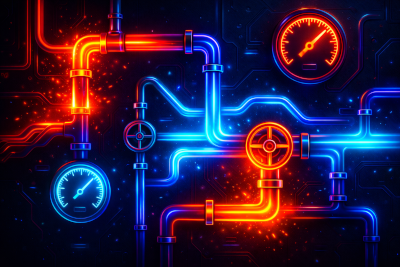
Every system that processes work follows the same basic pattern: something pushes work to be done, something executes it, and a queue forms in between. When production and consumption stay in balance, the system is stable. Otherwise, pressure builds.
Queues behave like pipes. Work flows in, work flows out, and anything that cannot move forward accumulates. As queues grow, latency increases and more time is spent waiting instead of executing.
Flow settles around an equilibrium defined by two forces: how fast work arrives and how fast it can be processed. When arrival rates exceed processing capacity, excess work accumulates as queue backlog.
Producers, Consumers, and Rate Mismatch
Every system has producers and consumers:
- Producers push work into the system.
- Consumers execute that work and move it forward.
Between them sits the gap that flow control has to manage. That gap exists because arrival rates fluctuate, execution capacity is finite, and imbalances are unavoidable.
The shape of that mismatch depends on a few dimensions:
- Rate determines how fast work arrives on average.
- Burstiness determines how uneven those arrivals are over time.
- Fan-out amplifies a single unit of work (1 producer → N consumers)
- Fan-in concentrates work into a shared bottleneck (N producers → 1 consumer)
Each of these increases the likelihood that arrival rates briefly exceed processing capacity.
Three Families of Flow Control
Flow control shows up in a few forms:
- Batching groups work together so fixed costs are amortized.
- Conflation reduces redundant work by dropping superseded work units.
- Backpressure enforces limits to prevent work from accumulating without bounds.
Each of these addresses a different source of pressure and is explored in more detail below.
Batching: Amortizing Fixed Costs

Batching groups multiple units of work so fixed overhead is incurred once per group. Many operations carry per-operation costs (kernel transitions, lock acquisitions, disk flushes) that do not scale with the amount of work being done. Batching amortizes that overhead across multiple units of work.
The immediate effect is higher throughput: the cost per unit of work drops as batch size grows. The tradeoff is an increase in mean latency, as work has to wait longer before being processed. Batching also smooths spikes in arrival rate, as they are absorbed into a batch instead of being processed individually, effectively reducing tail latency.
In practice, batching is controlled by two parameters:
- Maximum batch size bounds throughput gains
- Flush interval bounds latency
Batch size controls efficiency, while flush interval controls delay.
Conflation: Dropping History
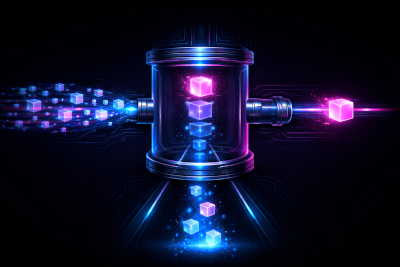
When multiple work units are pending, conflation allows only the latest one to be processed and discards the rest.
The key idea is that some streams represent state and not events. When only the current value matters, intermediate values lose their usefulness as soon as a newer one arrives.
Health signals illustrate this well: a stream of health updates represents the current condition of a service. Processing outdated signals wastes capacity and adds pressure for no benefit.
Conflation can dramatically lower CPU, memory, and network pressure at the cost of sacrificing history. When applied deliberately, it keeps systems responsive under load. When applied blindly, it erases the very information the system depends on.
Backpressure: Keeping Work Bounded
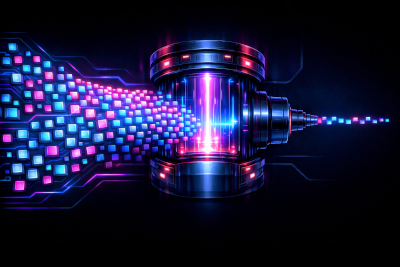
Backpressure is a mechanism that prevents work from advancing faster than the system can handle.
In any pipeline, work moves through stages at different speeds. When one stage slows down, work begins to accumulate behind it. Without a way to push that pressure backward, the backlog grows silently until it shows up as latency spikes, memory growth, or failure elsewhere. Backpressure makes that congestion visible by propagating it upstream.
How backpressure is applied depends on how work flows through the system:
- Push-based systems rely on bounds and rejection to limit producers.
- Pull-based systems let consumers control the rate of intake.
Backpressure turns overload into a controlled failure instead of a delayed catastrophe.
Are There Other Flow Control Mechanisms?
Yes, but they are variations or compositions of the same core ideas:
- Rate limiting constrains producers by capping how fast work is allowed to enter the system.
- Load shedding deliberately drops work when capacity is exceeded.
- Priority queues decide which work is allowed to proceed when resources are scarce.
- Admission control accepts or rejects work based on current conditions.
- Circuit breakers cut off entire paths when downstream systems are unhealthy.
Each of these deals with pressure in a different way, but none of them introduce a fundamentally new control surface. They are policies layered on top of batching, conflation, and backpressure.
Degradation Modes
Under sustained pressure, systems do not keep operating normally. Capacity is exhausted somewhere. The only remaining question is whether degradation is deliberate or accidental.
Well-designed systems define degradation modes explicitly:
- Streams can become conflated.
- Some paths may become partially disabled.
- Requests may time out sooner.
Each mode represents a deliberate reduction in fidelity or completeness to preserve stability and responsiveness. Designing degradation modes forces hard decisions early, expressed as rules that reflect business priorities.
Implementation Patterns and Tradeoffs
Several patterns show up repeatedly in low-latency systems:
- Token buckets and leaky buckets regulate how fast work is allowed to enter, smoothing out bursts.
- Bounded buffers apply hard limits and force an explicit overflow policy.
- Ring buffers paired with batch-draining loops provide predictable memory usage and high throughput.
Each of these comes with a tradeoff:
- Rate limiters favor stability over immediacy by slowing work instead of letting bursts propagate.
- Bounded buffers protect memory at the cost of loss or blocking.
- Batch-draining loops trade per-item latency for efficiency.
Low-latency systems have little margin for error. Small buffers and tight tail SLAs mean delays propagate immediately. Under these conditions, implementation details decide whether pressure is absorbed or amplified.
Observability and Tuning
Flow control only works if pressure can be observed. Otherwise, tuning becomes guesswork. Useful information can be derived from foundational metrics:
- Queue depth tracked over time reveals whether producers and consumers are balanced. Persistent growth, slow recovery, or sustained operation near capacity signal overload.
- Queue wait latency measures how long work sits buffered before execution.
- Flushed batch size distributions reveal whether work is being grouped as expected.
- Throughput and latency should be viewed together. A tail-latency × throughput heatmap shows how the system degrades under load.
- Late ratio (
processed_after_deadline / total) reveals the fraction of work that missed its expected time window.
Backpressure events are signals: blocked writes, rejected requests, delayed acknowledgements all point to a constraint being reached. Tracing those signals back to their root cause (e.g. CPU saturation, garbage collection) turns symptoms into actionable information.
Observability ties everything together. Tuning is the ongoing process of adjusting flow control parameters so pressure is absorbed early and released deliberately.
Closing: Flow Control Defines How Systems Fail
Overload, adversarial inputs, and dependency slowdowns are unavoidable. No system operates in isolation. What matters is how pressure unfolds, and flow control decisions determine the outcome. Batching trades delay for efficiency. Conflation trades history for volume. Backpressure trades acceptance for stability.
These tradeoffs define the shape of failure long before it happens.
Low-latency systems survive by staying predictable under stress. Controlled latency beats raw speed when pressure arrives. Deliberate loss beats accidental collapse. Explicit degradation beats silent failure.
Designing flow control well means deciding in advance what the system is willing to sacrifice when pressure rises.
📚 Low-Latency Fundamentals - Part 3
Previous articles
- Part 1: Understanding Latency: From Wire to Code
- Part 2: Latency Profiling in Python: From Code Bottlenecks to Observability